


언론보도
Connection may be humanity’s most important work (KOR)
- 2026.10.08
- 관리자
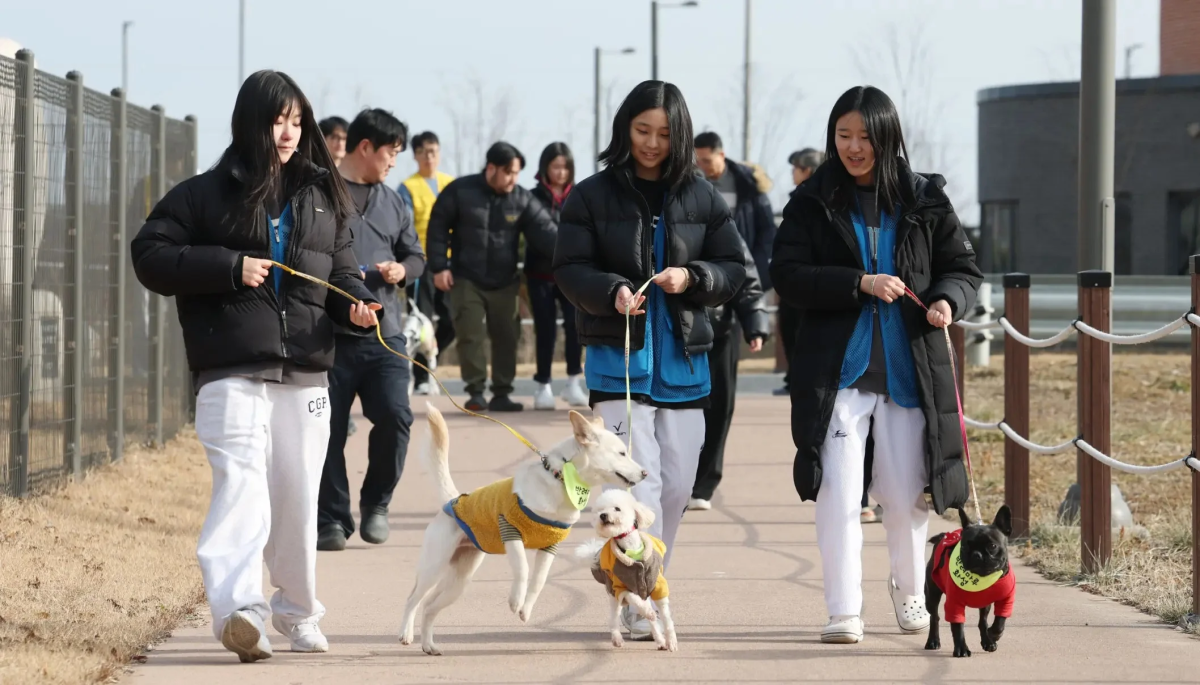
Teenage volunteers spend time with shelter animals at Banryeomaru Hwaseong, an animal welfare and adoption center in Mado-myeon, Hwaseong, Gyeonggi, on Jan. 14 during their winter vacation. About 6,000 people visit the center each year to take part in volunteer activities. Banryeomaru Hwaseong recruits volunteers throughout the year. NEWS1
AI is taking over many tasks, and advances will replace more labor. It writes reports, draws pictures, composes music, assists with counseling and supports decision-making. Technology that extends human capabilities is evolving rapidly.
Yet there is one task AI still cannot fully perform: connecting people and building relationships. That raises an unavoidable question: Are we becoming happier in the AI era, too?
We live in perhaps the most interconnected age in human history. We can reach almost anyone, anywhere, at any time. Paradoxically, however, loneliness and isolation are deepening. Information is abundant, but trust is declining. Communication has increased while relationships have become shallower.
AI can improve efficiency, but it cannot build trust between people for us. In “The Last Human Job: The Work of Connecting in a Disconnected World” (2024), sociologist Allison J. Pugh argues that even as automation replaces many forms of labor, the work of connecting people and building relationships remains distinctly human. Technology can calculate for us, but hospitality, empathy, solidarity and trust must be created by people. Those qualities depend on recognizing another person not as a data point or problem to be processed, but as someone with whom we share a community.
Perhaps the most important capability in the future will not be knowing more information but knowing how to connect people. I call this a “sense of connection”: the ability to recognize others, respect differences and form relationships that allow people to live together in a community. It may become both our scarcest and most valuable human capacity. In a society increasingly organized around automated systems, preserving that capacity is not nostalgia. It is a practical requirement for living together.
Volunteering is where this sense of connection can be learned most naturally. It is not simply a good deed performed to help someone. It brings different people together, builds trust, restores communities and accumulates social capital. If AI expands human intelligence, volunteering expands our capacity for connection.
The “World Happiness Report 2025” identified social support and generosity toward others, alongside material well-being, among important factors associated with happiness. In happier societies, people trust and willingly help one another. Happiness is not made alone. It is made through relationships.
Korea still falls short of these conditions. According to Statistics Korea’s social survey, the country’s volunteer participation rate was 14.4 percent in 2025. Participation has been recovering since the Covid-19 pandemic, but remains low considering the challenges posed by a super-aged society, a low birthrate, social isolation and climate disasters.
Volunteering should therefore be seen not merely as doing good but as a strategic investment in social resilience. The fully revised Framework Act on Volunteer Service changes the legal subject of volunteering from “citizens” to “individuals.” It declares that everyone living in Korean society, regardless of nationality, age or occupation, can help build the community. As diversity becomes part of everyday life, volunteering should become a public language of broader solidarity and hospitality. The change also expands the idea of civic participation beyond nationality, recognizing community membership through participation.
The United Nations Volunteers’ “2026 State of the World’s Volunteerism Report” estimates that 34.5 percent of the global working-age population, or about 2.1 billion people, volunteer each month. UNV views volunteering as a major force strengthening communities, complementing public services and advancing sustainable development. Yet it says volunteerism remains undervalued in policy and investment because much of its contribution is inadequately measured.
In Korea, 2,202,264 people, an average of 6,034 a day, participated in volunteer activities nationwide in 2025, according to national volunteer statistics. These figures show that volunteering is not a marginal activity but already a vast foundation supporting Korean society.
AI will take over more tasks and make humans smarter. But better societies are made by people. National competitiveness will not be determined by superior technology alone. A society’s future will ultimately depend on citizens who trust one another, welcome strangers and connect communities.
Connecting people may be humanity’s last job. Volunteering has quietly carried out that work longer and more widely than almost any other civic practice.
.
.
.
기사 원문 보러가기
